PCB Defect Detection — Beating Hand-Crafted Networks
ONE AI was tested on a published PCB defect detection dataset and compared against researcher-designed architectures, universal off-the-shelf networks, and traditional image processing.
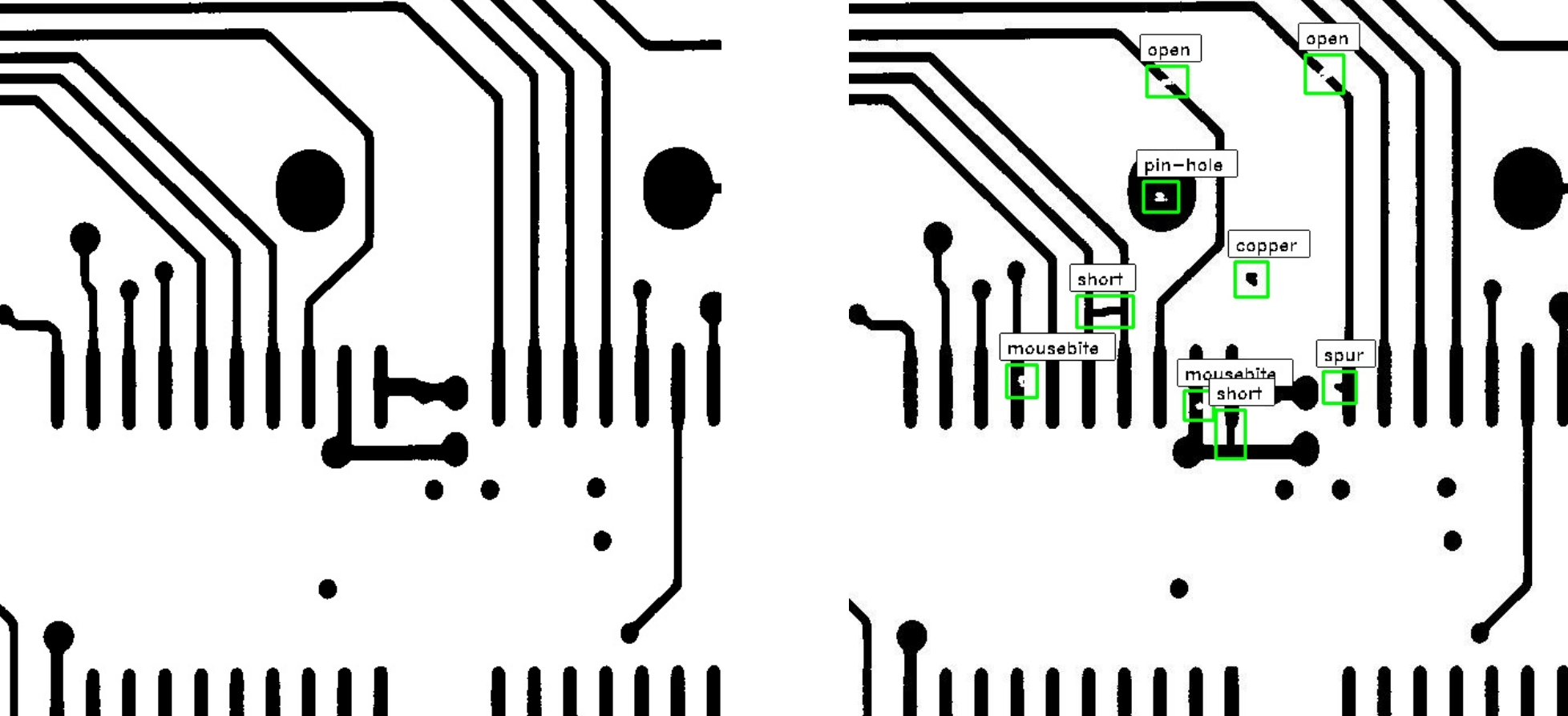
Dataset and baseline results from Ling et al. (2019) — PCB Defect Detection.
Results
| Model | F-Score | FPS (Titan X) |
|---|---|---|
| ONE AI | 98.4 % | ~465 |
| Human Scientists (custom ResNet18) | 98.2 % | 62 |
| Faster R-CNN | 97.8 % | 4 |
| SSD | 95.4 % | 64 |
| YOLO | 93.1 % | 34 |
| Traditional Image Processing | 89.8 % | 78 |
Key Findings
Higher Reliability
ONE AI achieved 98.4 % F-Score — surpassing even the hand-crafted architecture designed by domain experts (98.2 %).
Massive Speedup
The researchers' custom ResNet18 requires ~30 FLOPs (double application for two input images). ONE AI produced a lightweight architecture needing only ~4 FLOPs:
- 7.5× faster than the scientific model
- 116× faster than Faster R-CNN
No Manual Design Required
Unlike the researcher model that took specialized expertise and iteration to design, ONE AI found the optimal architecture automatically — in less time and with a better result.
Takeaway
Automated architecture optimization doesn't just match human-designed neural networks — it surpasses them in both accuracy and speed, by an order of magnitude.

Need Help? We're Here for You!
Christopher from our development team is ready to help with any questions about ONE AI usage, troubleshooting, or optimization. Don't hesitate to reach out!